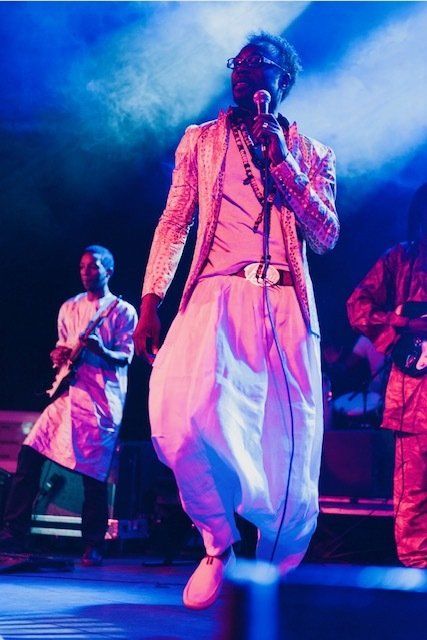
Abdoulaye Diabate (vocals, guitar) with African Jazz band Source - Sylvain Leroux - flute, alto sax, tambin (Fulani flute), sax Bailo Bah: tambin (Fula flute) Azouhouni Adou - keyboards. Mamadou Ba Robert Bonhomme: drums. Fusion of Jazz and world music with a strong emphasis on West African music on a deep intimate level with profound understanding of traditional African structures, acquired from prolonged studies, and years of experience with jazz and world music.
Composer, Singer of African and World Music
Born in Dakar, Senegal, singer and composer Alioune Guisse grew up in a family of African dancers and musicians. Alioune sings and composes contemporary and traditional African music in his native language of Wolof Fula, as well as, English and French. Alioune attended the Senegalese National School of the Arts majoring in African music.In 1996, Alioune formed his first band, Tim Timol playing traditional African music fused with Hip Hop and Rap. With Tim Timol, Alioune toured West Africa and Europe sponsored by the Belgian International Center for youth. In 2000, Alioune relocated to New York, USA where he joined the traditional West African Dance and Music company called Maimouna Keita. Alioune taught African music and songs for the company.In early 2004 Alioune returned to Senegal to release his first solo album entitled Machala. Machala is a fusion of traditional and contemporary African Music.
- GO TO TOP -
Awilo Longomba was born in Kinshasa (formally, Léopoldville). His father was from the Mongo region of the Ecuador and his mother was also from the Ecuador region of Ngombe and Congo Brazzaville. His father, Vicky Longomba, was the famous lead singer and founder of “Tout puissant OK Jazz” during the golden age of Congolese rumba, had a big influence on our artist. Since childhood, Awilo spent every waking moment in the music scenes attending his father rehearses. Very quickly his passion for music took, and he started cutting classes and started drumming for various groups of Kinshasa, including “l’orchestre de Lita Bembo. He joined the orchestra “Viva La Musica” led by the great Papa Wemba as a drummer, and Awilo had his real first taste of live performance on his first international tour in Europe and to Japan in 1985 and 1986.
As the fever he caught during his tour grew stronger, he decided to pursue his artistic carrier and moved to France. His reputation as one of the best drummers in France spread very quickly. This allowed him to collaborate on numerous records and tour worldwide with several African artists such as Tshala Muana, Oliver Ngoma, Kanda Bongo Man just to name a few. But Awilo’s ambition doesn't stop there; therefore, in 1992 he decided to leave “Viva La Musica” and formed his own group “La Nouvelle Génération” which he became the group leader. This new band became very popular in Europe and produced several albums.
In 1995, the career of Awilo, the singer, took off and he left “La Nouvelle Génération”. He released his first solo album “Moto Pamba” in which, he was the composer, the lead singer and of course the drummer. The Techno-Soukous star was born. His success couldn’t be ignored! He finally put the drums down and decided to concentrate on his singing and started touring in East Africa and in Europe. This first CD land him the “Best Central Africa Artist Awards” at the KORA AWARDS 1996 and 1997 (All Africa Music Awards, held in Sun City, South Africa) Since then, it has been non-stop for Awilo. His second tour in the studio validated his popularity. He released “Coupe Bibamba”, in 1998 with the collaboration of Jocelyne Beroard. The controversial title cut “Coupe Bibamba” that denounces poverty in Africa, hit the number 1 spot on the African and European charts very quick and stayed for several weeks. Several titles from the same CD followed.
In July 2000, Awilo released his third CD “Kafou Kafou” this CD sent him back to the KORA 2001 where Awilo was recognized for his outstanding contribution to African music and received “Judges Special Awards” during the KORA 2001. Awilo is not just a regular artist doing regular music, his live outstanding performances and popularity makes him the MOST WANTED Congolese artists on the African continent and Europe. He has toured in African counties such as Nigeria, Cameroon, Uganda, Tanzania, Burkina Faso, Kenya, Cote d'Ivoire, Benin, Togo Zambia, Gabon, Mali etc...). Awilo also has toured in Europe (Switzerland, Belgium, Great Britain etc…) as well as to the United States.
-Click Here for Videos-
- GO TO TOP -
From the northern, riverside town of Podor comes a modern musician filled with the mysteries of ancient Africa. Catlike and delicate in appearance, Baaba Maal sings with hurricane force. His music embraces the gentle filigree of West African folk, the tumult of mbalax and the toughness of rap and reggae.
Maal comes from the Toucouleur people who live in the Fulani fouta region, by the Senegal River, which divides Senegal and Mauritania. Young Baaba left home and moved to the Wolof-dominated capital Dakar to study music and explore his national culture. He soon returned to the north and spent a year with his group traveling along the Senegal River and learning from the old musicians village by village.
In 1982, Maal went to a conservatory in Paris, where he performed with his longtime friend the blind singer Mansour Seck. The duo pricked up ears in Europe with their intimate live recording, Djam Leelii. Maal returned to Senegal to form his current group, Dande Lenol, or “Voice of the Race.” The group has played a key role in African pop’s incorporation of hip-hop, reggae and techno, notably on their landmark 1994 release, Firin’ in Fouta. Other Maal releases with Dande Lenol include Lam Toro (1992), Nomad Soul (1997) and Live at Royal Festival Hall (1999).Maal also maintains an acoustic group that plays and records folkloric music. His 1991 acoustic release Baayo is a landmark Afropop recording, and Maal reprised its acoustic format on Missing You (Mi Yeewlii) (2001). A true original, Maal celebrates village life even as he advocates contemporary causes, including women’s rights in Africa. Like the griots he admires, Maal sings of history and heroes, bringing the lessons of the past into peoples’ lives today.
-Click Here for Videos-
- GO TO TOP -
Brilho de Luz Band is Brazilian Portuguese for Shining Light. Brilho de Luz takes listeners on an inspirational and melodious journey with their soulful and energizing rhythms. Their original music is composed of Afro-Brazilian beats strongly influenced by the samba, pagode and frevo music of Bahia, Brazil. The nine musicians and singers of Brilho de Luz fuse their sound with reggae, funk, soul, rock, rhythm & blues and hip-hop. The lyrics of their unique songs are sung in Portuguese and English. They play a variety of Brazilian and African percussion and folkloric instruments. Brilho de Luz inspires their audience with the timbal, surdo, djembe, congas, bacurinha, biribal, electric violin, flute, saxophone, piano, bass, guitar, and traditional drum set.
A special feature of the show is a Capoeira presentation. Capoeira is an ancient Brazilian martial art. Brilho de Luz's performance also includes the choreography of Brazilian and African dancers. Brilho de Luz has brought down the house at some of New York's hottest nightclubs and restaurants. They have also electrified their fans at outdoor festivals, colleges, corporate parties and state-sponsored cultural events. Brilho de Luz invites the young and old of all cultures to connect with their positive message and dance to its passionate beats! Let Brilho de Luz shine its light upon your soul!
- GO TO TOP -
CHARANGA SOLEIL brings together three of the world's greatest dance genres: Cuban salsa, Haitian compas, and Congolese rumba-soukous! In addition to the standard charanga instrumentation (flute, violin, piano, bass, conga, vocals and chorus), the group includes the Cuban tres and a full drum set, and sometimes even a 21-string West African kora (among other special guests).
The charanga ensemble - with its distinctive mix of violins and flute - migrated from Haiti to Santiago, Cuba in the late 18th century, with the addition of African-Caribbean percussion and vocal stylings in the 1920s. The modern Cuban charanga has endured as one of the most popular styles of Afro-Cuban music in the world, particularly in West Africa and Haiti.
All seasoned master musicians and bandleaders in their own right, the group's regular members are: Cathy Lopez (vocals); Goussy Celestin (vocals); Prof. Yaa-Lengi (vocals); Hadar Noiberg (flute, vocals, musical director); Lewis Kahn (violin, trombone); Junior Rivera (tres, vocals); Fred Doumbe (bass), Sergio Rivera (piano); Diego Lopez (drums); and John Berdeguer (percussion, vocals). Taking its name from RADIO SOLEIL D’HAITI (http://www.radiosoleil.com), Charanga Soleil reintroduces the tradition of a radio station represented by an orchestra or big band. A pioneer in Haitian-American radio broadcasting 24 hours a day, 7 days a week in three languages (Kreyol, French and English), RADIO SOLEIL transmits on an FM sub-signal from Brooklyn, NY to a listener base of more than 600,000 Haitians across a five-state area, as well as an ever-expanding international Internet audience. Along with comprehensive news programming, the station remains a showcase for Haitian and other world musics.
-Click Here for Videos-
- GO TO TOP -
Charmanto Nkole's brand of Soukous and Rumba music incorporates flavors from around urban Africa to create a contemporary and modern image of African music. Charmanto's performance is designed to uplift, inspire and touch the heart and soul of his audience. Strongly influenced by Papa Wemba, he incorporates folklore, rumba and soukous to sound just right. Through song and dance, Charmanto strives to promote a 100% positive outlook for humanity. He is one African artist whose aim is to make others feel very special. This goes back to the time when he became an advocate of human rights and the fight against AIDS in Africa. His message was loud and clear and international organizations such as Amnesty International adopted him as their spokesperson throughout Nigeria. This Congolese performer has made a name for himself by being the most extraordinary Rumba and Soukous singer and dancer to date. It has been said that Charmanto's electric performance on stage is and has always been amazing. He gives his energy to his audience; he dances his heart out like there is no tomorrow! His popularity grew to a point of sharing stages with such luminaries as Shaggy, King Sunny Ade, Papa Wemba, Awilo Longomba, Angelique Kidjo, Lagbaja, Femi Kuti, Ismael Lo, Wndo Kolosoy, Neil Oliver, etc. Charmanto is also a powerful force of Soukous and Rumba in North America today.
- GO TO TOP -
Traditional Senegalese Sabar music Cheikh M'Baye & Sing Sing Rhythmis a drum and dance company of Wolof griots from Medina, Senegal. Founded in 1987, the group is named for their ancestor, Sing Sing Faye, the first master drummer of the Cape Vert peninsula. They have performed and toured extensively in Africa, Europe, Canada, the Virgin Islands and the U.S., and have recorded with such luminaries as Peter Gabriel, Youssou N'Dour, Randy Weston, Jack DeJohnette, Angelique Kidjo and Craig Harris. Their CD, "Mame Bouna," is a true representation of the traditional rhythms of the Wolof people of Senegal.
- GO TO TOP -
Masters of “mbalax” dance rhythms, Fallou Dieng et le DLC are the foremost group to have emerged from Senegal in recent times. Hailed throughout West Africa as “le Roi de l’Ambiance,” Fallou has created some of Dakar’s most thrilling dance music, where cracking sabar drums, driving polyrhythms, funky guitar riffs and staccato horns are the perfect complement to his dynamic and versatile voice.
An engaging performer with a commanding stage presence, Fallou leads a new generation of popular artists who follow in the groundbreaking footsteps of his mentor, the international superstar Youssou N’Dour, who first introduced international audiences to “mbalax dur et pur” (hard and pure mbalax) – the Senegalese pop genre based on traditional sabar drum and dance.
Born at the dawn of Senegal’s independence, Fallou is the son of a marabout (spiritual leader). He was named after the distinguished marabout Serigne Fallou Mbacké, the son of Cheikh Amadou Bamba Mbacké, the legendary Sufi founder and leader of Mouridism. Coming of age in the 1970s, his generation was as influenced by Western styles such as soul, funk, jazz and rock, along with Cuban and Haitian big band music, as it was by Senegalese and other African traditional and popular styles. This unique fusion took root as mbalax (or mbalakh), becoming Senegal’s premier dance music as conceived and performed by such innovators as Etoile de Dakar (starring Youssou N'Dour and El Hadji Faye), Raam Daan (led by Thione Seck) and Super Diamono (featuring Omar Pene).
In the 1990s, Fallou came into his own as a singer, composer, arranger and bandleader with a different angle on mbalax. While many musicians in Senegal and elsewhere were replacing the big-band horn section with keyboards and synthesizers, Fallou added another trumpet to the line-up. His smooth, soaring vocal style, matched by the full, rich sound of his DLC band, ushered in a new movement called “ambiance” – and Fallou was crowned the “King of Ambience”.
Le DLC (named for the famed Dakar Loisir Club), which includes drums, keys, guitar, marimba, horns and backup singers, is driven by a powerful sabar drum orchestra that punctuates the musical phrasing with exhilarating rhythmic declarations.
With lyrics in Wolof, Serer and Toucouleur, reaching out to Senegal’s various ethnicities, Fallou sings about life’s hardships, urges lasting friendships, touts the values of loyalty, trust, truth and integrity, praises his faith, and stresses the importance of fighting for true love in a cultural milieu where arranged marriages are often the norm. Fallou’s steady stream of releases and incendiary live show have kept him in the limelight since his first hit record 15 years ago. After several cassette releases with Senegalese all-star group Lemzo Diamono in the early 1990s, Fallou formed his own group, le DLC. It was their second recording, Barsane (1994), that launched his career. Dubbed “Le Prince de la Medina,” he continued to turn out a string of smash hit albums in Senegal that never saw full international release but enjoyed much critical acclaim and gave rise to his enormous popularity: Beusseum-Bi and Biri Biri Dawal Thiow (both 1996); Weex Bet (1997); Diapason d’Enfer (2 volumes, 1998), and Prestige (2 volumes, 1999). Throughout the ‘90s, Fallou also appeared as a guest on recordings by such notable artists as Thione Seck and Seydina Ndiaye, and on a collaborative project with Youssou N’Dour, Baaba Maal and other mbalax stars.
In 2000 Fallou released his first CD, Medina (Stern’s Africa) – a compilation of major hit tracks from earlier, locally released cassettes – with international distribution. This was followed by Bouko Bayi (Africa Prod.), with more limited distribution, in 2003.
After signing with New York-based New African Production in 2005, Fallou’s international career finally took off. A showcase tour in the U.S. yielded the recording and release of Feuk Dieuf (New African Prod.) in 2006, which was critically acclaimed in both the U.S. and Africa and earned him the coveted Djembe D’Or award in 2007. A hit song from that same CD, “Le Diengou de Fallou”, was nominated for a Kora Award in 2008, under the Best Artist category in the heavily competitive West Africa region.
In 2007, following a sold-out tour promoted mainly to African audiences in the U.S., Fallou made his first appearance outside the Senegalese community, testing his appeal to a broader audience at Joe’s Pub, one of NYC’s premier venues. The positive response generated Fallou’s participation in NYC’s globalFEST in early 2008, which then led to a highly successful summer tour, performing at some of the most important festivals in the U.S. and Canada, including (among others): Central Park SummerStage, La Fête de Marquette, Toronto’s Afrofest and Sunfest, and two nights at Montreal’s Festival International Nuits d’Afrique, as well as KCRW’s World Festival at the Hollywood Bowl (where he shared the bill with American pop phenomenon Gnarls Barkley).
With a discography representing nearly 20 years as a major force in Senegal’s mbalax music scene, Fallou’s first truly comprehensive anthology CD, African Classics, was released in 2008 by the broadly distributed South African label Sheer Sound, by arrangement with New African Production.
-Click Here for Videos-
- GO TO TOP -
Kanda Bongo Man, born in 1955 in Inongo in the Belgian Congo (formerly Zaire) of the Bandundu people, is one of the foremost figures in modern African popular music. He left school at the age of 18 to join a local Kinshasa band, playing the hot rhumba sound of the time. He quickly moved on to play with the Orchestre Bella Mambo (later Bella Bella) in 1976 and toured Tanzania, Uganda, Kenya and Zaire with their newly created Soukous (from the French 'secouer', 'to shake'), a music style that is a cross between Caribbean rumba rhythms and traditional African music.
In 1979 Kanda Bongo Man moved to Paris and was offered a recording contract in 1981. Together with guitarists Diblo Dibala and Rigo Starr he developed his own melodious and catchy Soukous. He is most famous for the structural changes he implemented to soukous music. The previous approach was to sing several verses and have one guitar solo at the end of the song. He revolutionized soukous by encouraging guitar solos after every verse and even sometimes at the beginning of the song. He sings in Lingala, and his high speed form of soukous gave birth to the kwassa kwassa dance rhythm where the hips move back and forth while the hands move to follow the hips. "Zairean soukous is a lilting, rippling, dance groove that seems to smile from every register, with melody and rhythm inseparable. Kanda Bongo Man himself sings melodies that curl through the patterns like vines on a trellis." - New York Times
His 1981 album Iloye topped charts all over Africa and he went to release a string of classics on the Hannibal label, including Amour Fou and Kwassa Kwassa. In 1983 Kanda played WOMAD in the UK and his international reputation was born. He still tours frequently in Europe and the United States and in July of 2005 he performed at the LIVE 8: Africa Calling concert in Cornwall, England.
-Click Here for Videos-
-GO TO TOP -
Ibu hails from Podor, a small town in Senegal, Afrika. Ibu picked up the guitar at the age of twelve, starting a special relationship with music. Self taught, he studies music like one would study a language. Very early he found himself surrounded by various styles of music from Pulaar rhythms to American Blues and R&B.
"I remember listening to James Brown, Otis Redding without knowing what they were saying...there was a time I was nicknamed Wilson W. Pickett," Ibu says. "I had to focus on being an A student most of my youth, but music has always been a passion of mine. When I knew how to play few chords I started writing songs and accompanying other friends who used to sing with me. We would sit in front of the house and play till late at night." "When my studies took me first to Saint Louis and then to Dakar, I started dreaming of a career as a musician. I played in few bands in Saint Louis. When I was at the university I played in the band. The biggest thrill was, when the band played live on national television on a show called "Boulevard" hosted by Khalil Gueye."
In 1996 Ibu moved to Los Angeles,CA. He first started a band named Goree. The group played a fusion type style of music with Ibu on bass and vocals. Later on he focused more on studio work and studying engineering/production. Since the release of his first solo album Gaynde in 2001, Ibu has been performing solo acoustic shows, with his band or backing up other musicians at the Mirage, Bellagio and Alladin casinos in Las Vegas. Ibu Ba is currently recording his second album.
-Click Here for Videos-
- GO TO TOP -
Ndongo Bahoum Diop was born in Ziguinchor, which is the richest cultural city in Senegal, in July 1964. His nickname is Lucky. He belong to the Diola (jola) tribe, one the rare tribes where everybody is a musician! His father's position in the justice department gave him the great opportunity to learn about the dynamic music of the Toucouleur and the Wolof tribe at his early age. At the age of 10, Lucky was already performing for his classmates. In high school, he was among the first students to join the music band which won several competitions nationwide. During his last two years in high school, he collaborated with Solo Cissokho, a prominent kora player in Senegal. Lucky spiced up his compositions with sabar, bougarabou, seyrouba and djembe rhythms. As Solo’s repertoire became more diverse, they both gained more fans.
In 1987, he moved to the capital city Dakar, and enrolled at the University Check Anta Diop of Dakar (UCAD), as an English student. Despite his busy schedule, he created the first UCAD band while pursuing his musical ambitions. In 1988, he joined "Les Ballets Africains" of the well-known Zinzou.
In 1990, he attended the "Douta Seck National Conservatory of Music, Dance and Drama". For four years, he conducted extensive studies on the dances and music of the different ethnic groups in Senegal and took courses in balafon, kora, sabar and djembe. In 1991, he was an active member of the university's UCAD theater group, led by Ousmane Diakhate, now director of the Senegalese National Theater (Daniel Sorano). To refine his dance skills, he joined Le "Ballet Kouyakou", and the "African Dance Company" of Ahmed Kounta and Maissa Thioub, well-known masters of drums. In 1992, Lucky traveled to Italy where he shared the stage with the UCAD Theater and the "Sing-Sing Rhythm" during the new year’s celebration in Rome. Their performance was such a great success they were contracted for another show the following year.
During the 1992-1993 school year, he taught African drumming in "Cours Sainte Marie De Hann", one of the most reputable schools in Dakar. In 1993, he was assigned as the leader of "The Senegalese YMCA Cultural" program. He led performances during YMCA’s sponsored events throughout the Milwaukee area. In 1994, he earned his degree in Traditional African Music from the "Douta Seck National Conservatory of Music, Dance and Drama" in Dakar. In 1994, Lucky was given the opportunity through the YMCA International Exchange Program to continue his commitment to teaching African music in the U.S.A.. He opted to settle in Milwaukee, Wisconsin, where he is highly involved with the community and organizations committed to youth development. He has been performing and teaching traditional west African expressions of cultural values through drums, songs and dances. In 1996, he performed at the Epcot Center of Disney World in Florida for five days. In 1996, he performed 3 tracks as part of Narada's "African Voices" CD.
Upon his arrival in Milwaukee, Lucky wasted no time connecting with the community and youth organizations. His commitment to the wellbeing of children and the passion he exuberate for his Senegalese roots, are highly visible throughout his relationship with the following organizations: Boys and Girls Club, Parklawn YMCA, Carroll College, Wisconsin Conservatory of Music, Girls Scouts, International Institute of Milwaukee, Ko-Thi Dance Company, Marquette University, Milwaukee Repertory Theater, Milwaukee Public schools, Nefetari Dance Company, University of Wisconsin Milwaukee, Alliance Francaise, Summerfest, African World Festival, Rainbow Summer and Milwaukee Public Theater.
In 1998, lucky formed "Ajula", a youth African Drum and Dance ensemble. The word "Ajula" derives from the Diola language and it means "let's do it", "let's make it happen". With the co-sponsorship of the Milwaukee Public Theater and the Parklawn YMCA. "Ajula" became the first and the only professional youth African Drum and Dance group in Milwaukee. The performers are paid for each show and even rehearsals sometimes.
In 2003, Lucky created a new group called "Kassumai". "Kassumai" in the Diola tribe means, "May peace be with you". The troupe is Milwaukee's first professional youth troupe that plays traditional and modern African music, Afro-Jazz, Afro Hip-Hop, and World Music. "Kassumai"'s mission is to share the spirit of peace, love and unity wherever it performs. In 2003, Lucky released a new album titled "Kassumai Casamance" which means "Peace in Casamance". In 2004, Lucky started exposing his music and his troupe to other states in the USA. On March 20 2004, they did a very impressive show at "Satalla Night Club" in New-York City.
-Click Here for Videos-
- GO TO TOP -
MAIMOUNATA ("Maï") LINGANI is one of the most popular singers and songwriters of Burkina Faso, West Africa. She currently divides her time between New York City and Ouagadougou, the capital of Burkina Faso. Maï was born in Koudougou, Burkina Faso (formerly Upper Volta), grew up in Abidjan, Côte d'Ivoire, and started singing professionally during her late teens. In the mid-1990s, she won several prizes with bands playing styles ranging from reggae to the traditional musics of various Ivoirian ethnicities, and toured nationally. In 1996, she met the musicians Lukas Ligeti (of Austria, now residing in the U.S.) and Kurt Dahlke (of Germany)and participated in the recording of their group Beta Foly's critically acclaimed CD, her first international release ("Lukas Ligeti & Beta Foly", Intuition Records, Germany, 1997).
In 1997, Maï relocated to Ouagadougou, where she quickly became one of the most in-demand singers, both as a soloist and as a background vocalist. With the Orchestre Yumba, she was in residence at the Zaka, Ouaga's premier live music club, and developed her songwriting skills. In 1998, backed by the Yumba, she won the Grand Prix National de la Chanson Moderne Burkinabè, her country's most important music award; this launched her as a national celebrity, and in the following years, she made countless concert and TV appearances. Reuniting with Beta Foly, she toured Europe in 1999, performing at venues such as the Mozart Hall of the Konzerthaus in Vienna, Austria; the World Music Meeting in Nijmegen, The Netherlands; and the Museum of Contemporary Art in Strasbourg, France. During this time, she was also featured on many concerts and recording sessions of leading artists from Burkina and elsewhere such as Bil Aka Kora, Zedess, Martin N'Terry, and Askia Modibo, recorded in Germany with Kurt Dahlke's electronica group A Certain Frank ("Nothing", AtaTak/Caroline, Germany, 2001), and composed music for films by the well-known Burkinabè director, Fanta Régina Nacro. In 2000, she recorded her first solo album, "Entrons dans la danse", produced by Lukas Ligeti and released by the Burkinabè record label, Seydoni. The music of this album, with Maï's lyrics in the Moré, Dioula, Bissa, and French languages, combines a deep knowledge of Burkina Faso's traditional music with the openmindedness of a true musical innovator.
Since 2001, Maï has divided her time between Ouaga and New York. As a voice-electronics duo with Lukas Ligeti and featuring guest artists such as Abdoulaye Diabaté and Dafna Naphtali, she performed in numerous venues such as the United Nations Headquarters, the Massachusetts Museum of Contemporary Art, and Stanford and Sacramento State Universities. They also performed a highly unusual concert as part of the Ars Electronica Festival in Austria, Ligeti playing in a concert hall in Linz, Austria, and Lingani at a radio station in Ouagadougou, connected via a telephone line; the concert was broadcast live in both countries. In America, Maï has also collaborated with artists such as Sylvain Leroux & Source, Balla Tounkara, Francis M'Bappé, Akoya Afrobeat Ensemble, Kaleta, New York African Chorus, and many others, performing at clubs in New York and elsewhere; at the Schomburg Center for Black Culture; Floydfest in Floyd, VA; the Nuits d'Afrique Festival in Montreal, and as far afield as the Salmon Run Festival in Kelowna, BC; as an accompanist, she was called to back up fellow African stars such as Monique Seka, Nayanka Bell, King Angelo, and others. She was also featured by seminal jazz artist Paul Winter in his Winter Solstice Celebration concerts at New York's Cathedral of St. John the Divine.
In 2004, she co-founded the group Burkina Electric with her longtime associates, Lukas Ligeti, Kurt Dahlke, and Burkinabè guitarist Wende K. Blass. The group's objective is to bring new concepts to both Burkinabè music and Western club electronica by infusing computer-based performance with rhythms and other elements of Burkinabè traditons. A first, very successful tour took place in Austria in 2004. The group has just finished recording its first CD, which will be released in Burkina Faso in May, 2006, when Burkina Electric will be featured at this year's Ouagadougou Jazz Festival.
-Click Here for Videos-
- GO TO TOP -
Born in Senegal, West Africa, Meta Dia grew a deep love and true appreciation for all types of music. Moving to the USA in 2002, he began to collaborate with artists such as Sean Blackman, hip-hop pioneer Toni Blackman and many others. Meta's powerful writing skills and his phenomenal singing voice take you back to the roots of Reggae music, as he infuses his songs with hip hop, rock, soul, and African influences, singing in English, French, Wolof and Fulani. The afro-fusion reggae of the Cornerstones and Meta's soulful, soaring voice creates a soul-pounding experience for the audience. Meta is creating something bigger than music, transcending oceans, borders, and languages. The power of what he is contributing is unifying and humbling. Meta and the Cornerstones have something big to offer whoever is listening..
-Click Here for Videos-
- GO TO TOP -
Mor Dior is a prince, originating from one of the most famous families of royal Griots, “Bour Guewels” of Senegal. At a very early stage in his life made himself knows as both an actor and singer. He was noticed by the Director of the Academy of Music and chosen to become lead vocalist for the local band I.N.A.S.
He stayed four years with the group sharing the stage with big names on the African music scene like, Manu Dibango, “Soul Makossa”, El Maestro Laba Sosseh, Bocana Maiga, Aicha Kone, Francois Louga and Harry Belafonte. During those exciting years he also came into contact with international artists performing in Dakar such as, Jimmy Cliff, Mick Jagger, Johnny Halliday, Burning Spear, Stevie Wonder and many others. Mor Dior Bamba is back. He is back with his band of professional musicians and female dancers.
- GO TO TOP -
Ramatou Diakite grew up in one of Africa's richest musical environments, the Wassoulou region of southern Mali. Renowned for its ancient spiritual traditions, magic, and hunters' lore, Wassoulou has also produced the bluesiest, funkiest traditional pop music in modern Mali. Ramatou broke onto the scene in the wake of singer Oumou Sangare's spectacular rise in the early 90s. Oumou's bold fusion of roots and pop, and her willingness to sing honestly about the challenges facing African women marked a generation. In her own time, Ramatou set out to go further, edging towards hip-hop on her first international album, and going on to create music unlike anything heard before in Mali or elsewhere. A soulful, standout singer in a nation of standout singers, Ramatou is now poised to share her path-breaking music with a worldwide audience.
- GO TO TOP -
On March 5th, 1989 two men, Lokassa Ya Mbongo and Ngouma Lokito put together a band: SOUKOUS STARS. The band members were Paris Shimita, Yondo Sister, Balu and Zitani Nell. The press conference was held at “New Morning” hotel in Paris. Many international stars such as Manu Dibamgo, Jacob Desvarieux, Jocelyn Berouard, Sam Mangwana, just to name a few, were present. Giants of communication RFI (Radio France International, Africa Not, etc broadcast the event. The band, once put together, did a lot of live concerts around the world with many African stars. As the years passed, SOUKOUS STARS became bigger and more famous. Talented artists from various countries in Africa joined the group. Yondo Sister, Shimita, Nyomba, Luciana de Mingongo from Kinshasa, Democratic Republic of Congo; Ballu Canta, Zitani Nell, Pierre Belcos, Lucien Bokilo, from Congo Brazzaville; Saladin from Central Africa Republic; Arsene Kounde from Benin and Joseph Koujojo from Cameroon.
SOUKOUS STARS are the winners of the 22nd Annual International Reggae & World Music Festival Winners of the Best Soukous Entertainer Award (2003). SOUKOUS STARS are one of those rare bands that work with various musicians from different backgrounds and with different styles. Their repertoire is comprehensive and they are true representatives of World Music, they are able to play any kind of music from anywhere. When SOUKOUS STARS are on stage with any artist, the show is a guaranteed success.
-Click Here for Videos-
- GO TO TOP -
A group of friends who share a passion for music, the members of Waflash grew up together in a town called Thiés, approximately 70 miles east of Dakar, the capital of Senegal. In 1988, while they were still in school, Senegal experienced a crisis in which students went on strike to demand better materials for their studies. As a result, many students did not go to school that year. This became an opportunity for the members of Waflash to focus their attention on music. The group was formed in 1990 and they recorded their first demo. DJ Michael Soumah, of Dakar FM radio, introduced them to the Senegalese public, and from there they began playing at concerts, festivals and clubs all over West Africa. After the official release of their first album, "Yoon wi", in 1996, Waflash became a great hope for the region of Thiés and one of the most well-respected groups in Senegal. That album was followed by "Prosper" (1999), "Gotel" (2001) and "Gorgui" (2002). In 2003, their collaboration with American musician Ken Stringfellow produced two CDs, "Mappando" and "Bella Casa". In 2005 they released "Yow nit", and then their first live CD/DVD, "Anniversaire", in 2006. Currently, the band is working with Kavall Records, a French label, to release a CD for the international market.
In a country where mbalax remains the dominant music, the collective vision of these childhood friends from Thiés, the city famously known for its railroad intersections, puts Waflash at the forefront of Senegalese music. Artfully blending African and Western musical genres, their sound reflects a broad range of influences such as Senegalese mbalax and bougarabou, soul, jazz, Afrobeat and more. Their songs speak to the themes of love, environment, women's issues, and a united Africa. The group's presentation is made even more lively with innovative choreography and artful attire. The band's lead singer, Masane, is already considered one of the greatest female artists Senegal has ever produced. She represents a new generation of African women singers who aspire to break through the restrictions of traditional social roles and a male-dominated industry. At the age of 33, Masane has the stage presence and polished appearance of an experienced performer. Her music is clearly inspired by the R&B, hip-hop and radio pop that have globalized her generation, yet her voice is genuine and she remains true to her Senegalese roots.
Since proving their universal appeal, Waflash has toured the Continent from Algeria to South Africa, as well as Europe, including France, Italy, Germany, England and Switzerland. In 2006, they represented Senegal at the summit of French-speaking nations held in Bucharest, Romania. Yet another European tour in 2007 included the Selam African festival in Stockholm, Sweden. In April 2008, they toured Spain, France and Switzerland, and have been playing in Germany and France since November 2008.
But the group's ambition is not limited to releasing CDs and organizing concerts. In December 2007, they founded the Palais des Arts (Palace of Arts) in their native city of Thiés – a "concert-café" comprised of a concert hall, restaurant, bar, cyber café, and exhibition space – where they perform, invite other groups and host a variety of artistic and cultural events.
-Click Here for Videos-
- GO TO TOP -
A native of Togo, West Africa, Yawo started his musical career at the “Ecole Experimentale de musique” of Lome, where he studied flute, classical guitar, and electric bass. As the leader of the high school band he formed with his brother and sister, Yawo Attivor developed a talent for composing and arranging music that embraces both the traditions of the Ewe tribe and the influences of the western civilization. This multicultural approach to songwriting led to the creation of the MIMI-Togo (International Movement for Innovative music-Togo branch) which Yawo directed until he left Togo in 1992 as a result of political turmoil in his motherland. In 1993, Yawo joined the international organization Up With People, traveling the U.S. and Europe, promoting peace and understanding among the citizens of the world. After Up with People, Yawo, his cousin Ro Attivor (aka Ro Bezz), Sarah Agbeto and guitarist Matt Hupton created Doliho, an afropop project that rocked the Midwest with a unique album in the late 90s. In 2002, after he moved to Minneapolis a year earlier, Yawo launched a solo career with the album “Celebrate” (Mia du agbe) followed in October 2004 by “Take out the fences”, a “refreshingly upbeat” (Minneapolis Star tribune) album that breaks musical barriers with an explosion of afro-beat, afro-funk and reggae.
-Click Here for Videos-
- GO TO TOP -
Grupo Caribe is a swinging Mambo Salsa Dance Band based in New York City! The band performs traditional Salsa dance music with pulsating percussive riffs, steady piano and bass montuno vamps, adorned by a rhythmic and melodic brass section, and full-bodied vocals reminiscent of the 1960’s and 70’s.
Grupo Caribe have been featured performers in NYC’s Lincoln Center’s Mid Summer Night Swing, the Battery Park Concert Series, and three concert performances at the Tempo-Latino Festival n Toulous, France. Grupo Caribe has also performed at venues such as the Plaza Hotel, the Waldorf Hotel, the Brooklyn Academy of Music Café, SOBs, and on the Banco Popular Float in the Puerto Rican Day Parade.
Grupo Caribe’s four CDs and performances include a variety of Mambo/Salsa arrangements including the popular rhythms of Guaguanco, Guaracha, Compparsa, Cha Cha Cha, Bomba, Plena, Bolero and Latin Jazz. The compositions are from famous Latin prolific writers such as Pedro Flores, Rafael Hernandez, Ignacio Piniero, and Chano Pozo. The arrangements are by musicians who are very active in the Salsa scene such as Oscar Hernandez, Ray Santos, Jose Madera, Louis Bauzo, Pepe Castillo, David Forestier, and Sergio Rivera. Grupo Caribe’s music is distributed throughout the USA, Asia, Australia, and Africa by G.B. Records based in New York City, and throughout Europe by Walboomers Music based in Holland.
Grupo Caribe’s Fourth CD “Somos Caribenos” includes 10 tracks of which seven are original compositions and three are Salsa classics with a new millennium dressing. It also features three of the most popular singers in NY City today; Herman Olivera, Luisito Ayala, and Tito Allen. The personnel in the band are all veteran musicians and have played with the best Latin bands in the business including; Tito Puente, Machito, Larry Harlow, Eddie Palmieri, Mongo Santamaria, and Willie Colon. Sergio Rivera Director, Pianist, composer and arranger has performed with Raphael Cortijo, Kako Y Sus Estrellas, Orestes Vilato Y Los Kimbos and The Orlando Marin Orchestra.
-Click Here for Videos-
- GO TO TOP -
Mayoro Ndiaye a.k.a Yoro has always shown a keen interest in art, particularly music. At an early age, while he was still in elementary school, Yoro used to hide in his father's joinery workshop to create his own hand-made guitars. He also got close to local musicians of Mbacke his hometown (250km from Dakar in the Central Senegal) in those days and that helped him get a solid knowledge on the basics of music but also to gain an experience of the world of music which is nowadays helping him to better handle his career as a professional musician.
At the same time as he studied, Yoro pursued his passion for music and decided after he graduated from secondary school to join the regional band of Diourbel. He stayed there for two years learning a lot more about music but mainly about performing. As his love for music grew, Yoro felt that it was definitely his future and dropped out of school one year before graduating from university. That was the beginning of his solo career. On stage with only his guitar, he travelled throughout the whole centre of Senegal, playing gigs mainly in schools which helped him to develop a die-hard fan base that still supports him. But Yoro's dreams were bigger than Mbacke which he felt, kept him away from the real Senegalese music scene despite some appearances in the local press. Due to the distance from almost everything and the lack of infrastructures to promote artists, Mbacke was no longer the place to fulfill his dreams.
In 2000, he moved in Dakar, capital city of Senegal and formed his band Le Yoon Wi (“The Way”). As he struggled to make his mark on the Dakar music scene, he survived doing various jobs including working for the Club Med Hotel of Dakar as an instructor. That job helped him to obtain a contract for a weekly performance at the same hotel. Over the next three years, Yoro performed there every Tuesday. In 2002, however, Yoro released the Africa track in the first Senegalese folk music compilation called "Senegal Folk" next to national celebrities like Souleymane Faye and Pape Niang. In 2003, he drew Youssou Ndour's attention who lent him a hand by booking him as a supporting act for his performances in the mythical Thiossane venue.
In 2004 Yoro and Le Yoon Wi released their first album titled "Beug Dèm" (Dreams Of Leaving) and captured the attention of Senegal. That album was released in three parts, six tracks only on the Senegalese market that year while the same album was released in Italy the following year but with eleven tracks. In 2007 the other seven tracks were then released in Senegal under the title "Nittou Nitt" (Friend Of a Man). Yoro has since become a real phenomenon in Senegal and his popularity grows day after day. His performances in different venues in Dakar are now the most attended and his track "Xaritt" has been acclaimed Hit of the year. He is now considered by his peers to be a leader of Senegalese music's new generation, a voice that has to be heard.
-Click Here for Videos-
- GO TO TOP -